Classic Inca Trail
The famous one. Permits cap at 500 per day (including porters and guides — about 200 trekkers). Sells out 6-8 months ahead. Closed every February for maintenance.
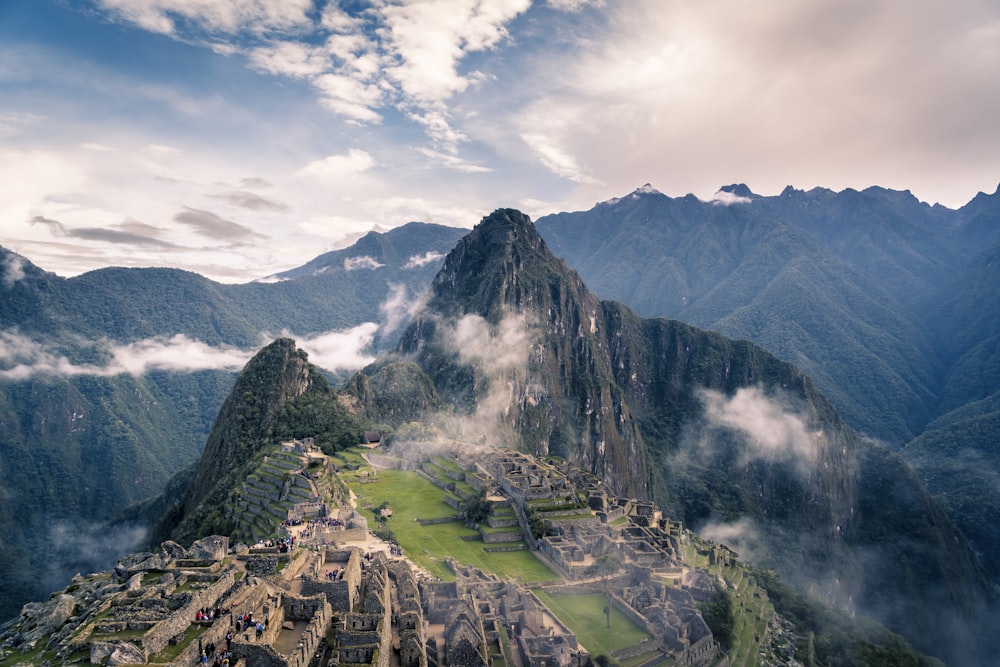
The citadel sits in a cloud forest, perched 2,430 m above sea level, accessible only by train or by foot. Every route begins in Cusco, passes through the Sacred Valley, and ends in the small town of Aguas Calientes (Machu Picchu Pueblo) at the base of the mountain.
Two operators run the rails into Aguas Calientes — PeruRail and Inca Rail. Both depart from Ollantaytambo (the most common starting point) or Poroy, near Cusco. The journey takes 1.5 to 2 hours and follows the Urubamba River through the cloud forest.
Trains range from "Expedition" basic class at around $110 round trip to the legendary Hiram Bingham luxury train at $600+ with white-tablecloth dining, an observation car, and live Andean music.
For most travelers, the Vistadome (PeruRail) or 360° (Inca Rail) classes are the sweet spot — panoramic windows, light snacks, comfortable seating.
See Train Classes
From Aguas Calientes, the only motorized access to the citadel entrance is the Consettur shuttle bus. It runs continuously from 05:30 to 15:30, climbs the 8 km of switchbacks in roughly 25 minutes, and returns down the same way.
Round trip costs around $24 USD. Tickets can be bought online or at the Consettur office in Aguas Calientes — bring your passport.
The alternative is the foot path: a 1.5-2 hour climb up roughly 1,800 stone steps. It's free, beautiful, and brutally steep. Most people walk down rather than up.
Aguas Calientes (officially renamed Machu Picchu Pueblo) is a small, dense, slightly chaotic town wedged between two cliffs and a river, built almost entirely to serve Machu Picchu visitors. There are no cars. Everything is walkable in 15 minutes.
It has roughly 100 hotels, a hot springs complex, a Sunday market, the Machu Picchu Museum (Manuel Chávez Ballón), and a long pedestrian strip of restaurants of varying quality. Food costs 30-50% more than in Cusco. ATMs work but exchange rates are 3-5% worse than at the Cusco branches.
Where to stay: Anywhere within a 10-minute walk of the train station or the bus stop is fine. The town is too small for "good neighborhoods." If you have an early entry, stay close to the bus stop.
How long to stay: One night is enough for most visitors. Two nights makes sense if you want a sunrise visit on day two, or if you're climbing both Huayna Picchu and Machu Picchu Mountain on different days (you cannot do both on the same ticket).
Five major trails approach the citadel on foot. Some require permits. None are easy.
The famous one. Permits cap at 500 per day (including porters and guides — about 200 trekkers). Sells out 6-8 months ahead. Closed every February for maintenance.
No permit cap. Crosses the Salkantay Pass at 4,630 m. More challenging, more solitude, dramatic glacier views. The most popular alternative to the classic.
A hybrid of mountain biking, rafting, and zip-lining with hiking sections. Less archaeological, more adrenaline. Popular with younger travelers.
A cultural trek through Andean weaving communities. Less about the destination, more about the people living above 4,000 m today. The quietest of the alternatives.
A condensed version of the classic — a single full hike day from KM 104, ending at the Sun Gate. Permit also required, but more available than the 4-day.
The budget backdoor: minivan to the Hidroeléctrica station, then a 3-hour walk along the railway tracks into Aguas Calientes. Saves $100-150 vs the train. Costs a full day each way.